
RAG Best Practices
Retrieval-Augmented Generation (RAG) is a powerful technique that enhances Large Language Models (LLMs) by providing them with external knowledge. This guide covers best practices for implementing efficient and effective RAG pipelines using AvalAI.
This guide is adapted from the Best Practices for RAG Pipeline with modifications for AvalAI's implementation.
Introduction to RAG
RAG combines the strengths of retrieval-based and generation-based approaches to create more accurate, factual, and contextually relevant responses. Instead of relying solely on knowledge encoded in the model's parameters, RAG retrieves relevant information from external sources and uses it to augment the context provided to the language model.
Key Benefits of RAG
- Improved Accuracy: Access to up-to-date and domain-specific information
- Reduced Hallucinations: Grounding responses in factual information
- Knowledge Extensibility: Easily update knowledge without retraining the model
- Source Attribution: Ability to cite sources of information
RAG Workflow Components
A typical RAG pipeline consists of several key components:
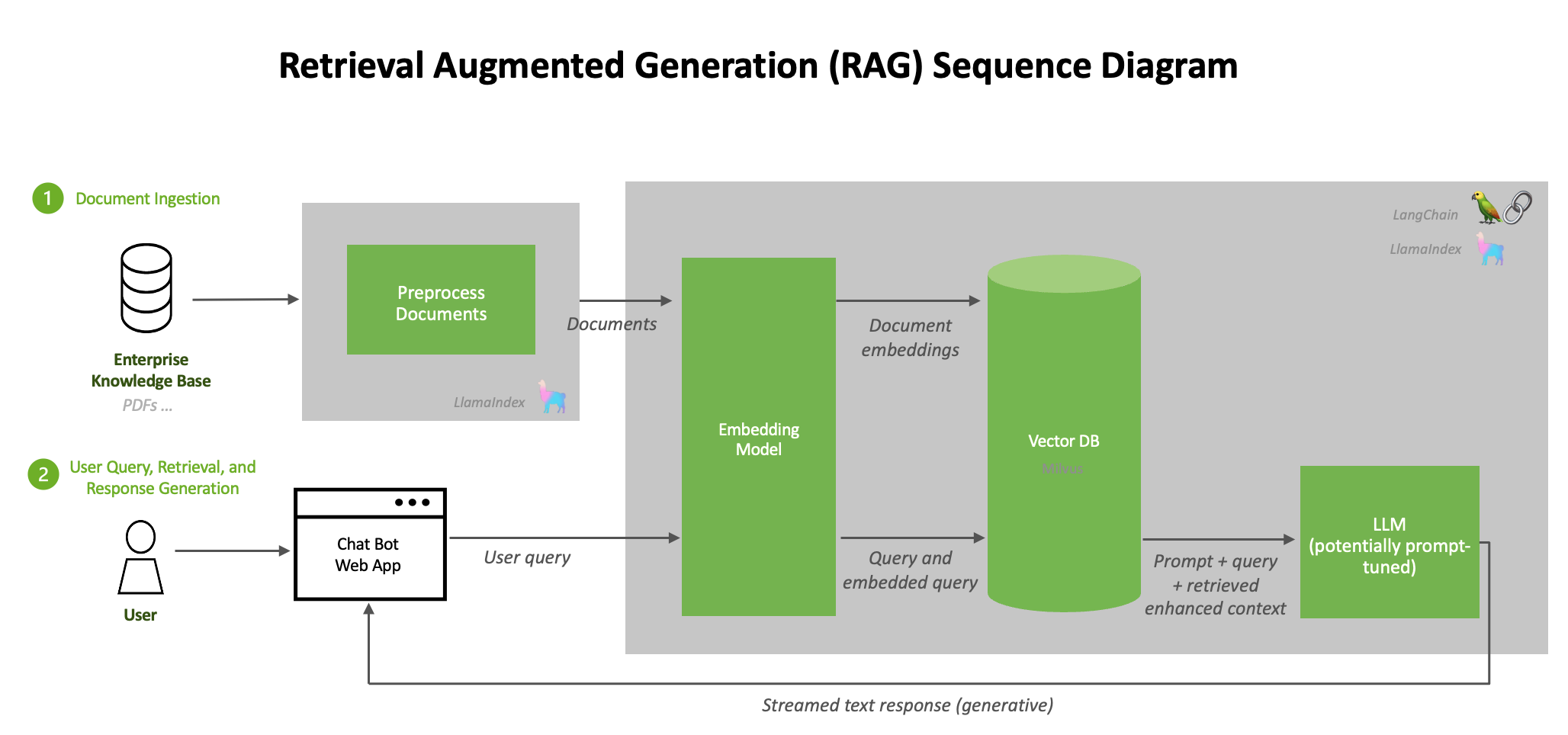
- Query Classification: Determining if external retrieval is needed
- Document Chunking: Breaking documents into manageable pieces
- Embedding Generation: Converting text into vector representations
- Vector Storage: Efficiently storing and searching embeddings
- Retrieval: Finding relevant documents for a given query
- Re-ranking: Improving relevance of retrieved documents
- Re-packing: Organizing documents for optimal context utilization
- Summarization: Condensing information to fit context windows
- Generation: Producing the final response
Let's explore each component in detail along with best practices.
1. Query Classification
Not all queries require external retrieval. Implementing query classification can optimize performance by determining when to use RAG.
Best Practices
- Use a classifier to identify queries that need external information
- Skip retrieval for queries that can be answered with the model's internal knowledge
- Consider the task type when determining retrieval necessity
from openai import OpenAI

client = OpenAI(
    api_key="your-avalai-api-key",
    base_url="https://api.avalai.ir/v1",  # AvalAI API endpoint
)


def classify_query(query):
    """Determine if a query requires external retrieval."""
    response = client.chat.completions.create(
        model="gpt-5.6-luna",
        messages=[
            {
                "role": "system",
                "content": "You are a query classifier. Respond with 'RETRIEVE' if the query requires external knowledge, or 'SUFFICIENT' if the model's knowledge is enough.",
            },
            {"role": "user", "content": query},
        ],
    )
    classification = response.choices[0].message.content
    return "RETRIEVE" in classification


# Example usage
query = "What were the key announcements at AvalAI's 2025 developer conference?"
if classify_query(query):
    # Proceed with RAG pipeline
    print("Retrieving external information...")
else:
    # Use standard completion
print("Using model's internal knowledge...")import { OpenAI } from "openai";
const client = new OpenAI({
apiKey: process.env.AVALAI_API_KEY,
baseURL: "https://api.avalai.ir/v1", // AvalAI API endpoint
});
async function classifyQuery(query) {
// Determine if a query requires external retrieval
const response = await client.chat.completions.create({
model: "gpt-5.6-luna",
messages: [
{
role: "system",
content:
"You are a query classifier. Respond with 'RETRIEVE' if the query requires external knowledge, or 'SUFFICIENT' if the model's knowledge is enough.",
},
{ role: "user", content: query },
],
});
const classification = response.choices[0].message.content;
return classification.includes("RETRIEVE");
}
// Example usage
async function processQuery(query) {
const needsRetrieval = await classifyQuery(query);
if (needsRetrieval) {
// Proceed with RAG pipeline
console.log("Retrieving external information...");
} else {
// Use standard completion
console.log("Using model's internal knowledge...");
}
}
processQuery(
"What were the key announcements at AvalAI's 2025 developer conference?",
);# Using cURL to classify a query
curl https://api.avalai.ir/v1/chat/completions \
-H "Content-Type: application/json" \
-H "Authorization: Bearer $AVALAI_API_KEY" \
-d '{
"model": "gpt-5.6-luna",
"messages": [
{
"role": "system",
"content": "You are a query classifier. Respond with '\''RETRIEVE'\'' if the query requires external knowledge, or '\''SUFFICIENT'\'' if the model'\''s knowledge is enough."
},
{
"role": "user",
"content": "What were the key announcements at AvalAI'\''s 2025 developer conference?"
}
]
}'package main
import (
"context"
"fmt"
openai "github.com/openai/openai-go"
"strings"
)
func classifyQuery(client *openai.Client, query string) (bool, error) {
// Determine if a query requires external retrieval
resp, err := client.CreateChatCompletion(
context.Background(),
openai.ChatCompletionRequest{
model: "gpt-5.6-luna",
Messages: []openai.ChatCompletionMessage{
{
Role: openai.ChatMessageRoleSystem,
Content: "You are a query classifier. Respond with 'RETRIEVE' if the query requires external knowledge, or 'SUFFICIENT' if the model's knowledge is enough.",
},
{
Role: openai.ChatMessageRoleUser,
Content: query,
},
},
},
)
if err != nil {
return false, err
}
classification := resp.Choices[0].Message.Content
return strings.Contains(classification, "RETRIEVE"), nil
}
func main() {
client := openai.NewClient("YOUR_AVALAI_API_KEY")
client.BaseURL = "https://api.avalai.ir/v1" // AvalAI API endpoint
query := "What were the key announcements at AvalAI's 2025 developer conference?"
needsRetrieval, err := classifyQuery(client, query)
if err != nil {
fmt.Printf("Error: %v\n", err)
return
}
if needsRetrieval {
// Proceed with RAG pipeline
fmt.Println("Retrieving external information...")
} else {
// Use standard completion
fmt.Println("Using model's internal knowledge...")
}
}<?php
// Using PHP to classify a query
$apiKey = getenv('AVALAI_API_KEY');
$apiUrl = 'https://api.avalai.ir/v1/chat/completions';
function classifyQuery($query, $apiKey, $apiUrl) {
$data = [
'model' => 'gpt-5.6-luna',
'messages' => [
[
'role' => 'system',
'content' => "You are a query classifier. Respond with 'RETRIEVE' if the query requires external knowledge, or 'SUFFICIENT' if the model's knowledge is enough."
],
[
'role' => 'user',
'content' => $query
]
]
];
$jsonData = json_encode($data);
$ch = curl_init($apiUrl);
curl_setopt($ch, CURLOPT_RETURNTRANSFER, true);
curl_setopt($ch, CURLOPT_POST, true);
curl_setopt($ch, CURLOPT_POSTFIELDS, $jsonData);
curl_setopt($ch, CURLOPT_HTTPHEADER, [
'Content-Type: application/json',
'Authorization: Bearer ' . $apiKey,
'Content-Length: ' . strlen($jsonData)
]);
$response = curl_exec($ch);
$err = curl_error($ch);
curl_close($ch);
if ($err) {
throw new Exception("cURL Error: " . $err);
}
$responseData = json_decode($response, true);
$classification = $responseData['choices'][0]['message']['content'];
return strpos($classification, 'RETRIEVE') !== false;
}
// Example usage
$query = "What were the key announcements at AvalAI's 2025 developer conference?";
try {
$needsRetrieval = classifyQuery($query, $apiKey, $apiUrl);
if ($needsRetrieval) {
// Proceed with RAG pipeline
echo "Retrieving external information...";
} else {
// Use standard completion
echo "Using model's internal knowledge...";
}
} catch (Exception $e) {
echo "Error: " . $e->getMessage();
}
?>Responses API version
Use this version when the selected model supports /v1/responses. messages moves to input, and the final text is read from response.output_text.
import os
from openai import OpenAI

client = OpenAI(
    api_key=os.environ["AVALAI_API_KEY"],
    base_url="https://api.avalai.ir/v1",
)

response = client.responses.create(
    model="gpt-5.6-luna",
    instructions="You are a helpful assistant.",
    input="What were the key announcements at AvalAI",
)

print(response.output_text)import OpenAI from "openai";
const client = new OpenAI({
apiKey: process.env.AVALAI_API_KEY,
baseURL: "https://api.avalai.ir/v1",
});
const response = await client.responses.create({
model: "gpt-5.6-luna",
instructions: "You are a helpful assistant.",
input: "What were the key announcements at AvalAI",
});
console.log(response.output_text);curl https://api.avalai.ir/v1/responses \
-H "Content-Type: application/json" \
-H "Authorization: Bearer $AVALAI_API_KEY" \
-d '
{
"model": "gpt-5.6-luna",
"input": "What were the key announcements at AvalAI",
"instructions": "You are a helpful assistant."
}'messages→input- system message →
instructionsor adeveloperitem choices[0].message.content→response.output_text- for tools and multimodal output, inspect
response.outputby itemtype.
2. Document Chunking
Breaking documents into appropriate chunks is crucial for effective retrieval. The chunking strategy affects both retrieval accuracy and processing efficiency.
Chunking Strategies
- Token-level chunking: Splits by fixed token count
- Sentence-level chunking: Breaks at sentence boundaries
- Semantic-level chunking: Uses LLMs to identify natural breakpoints
Best Practices
- Chunk Size: Use 512-1024 tokens for optimal balance between context and relevance
- Overlap: Include 10-20% overlap between chunks to maintain context
- Preserve Semantics: Try to keep semantically related content together
- Metadata: Enhance chunks with titles, section headers, and other metadata
from openai import OpenAI
import nltk
from nltk.tokenize import sent_tokenize

# Download NLTK resources if not already available
nltk.download("punkt")


def chunk_document_by_sentences(document, max_chunk_size=512, overlap=20):
    """
    Chunk a document by sentences with specified overlap.

    Args:
        document: The text document to chunk
        max_chunk_size: Maximum chunk size in tokens (approximate)
        overlap: Number of sentences to overlap between chunks

    Returns:
        List of document chunks
    """
    # Split the document into sentences
    sentences = sent_tokenize(document)

    chunks = []
    current_chunk = []
    current_size = 0

    for sentence in sentences:
        # Approximate token count (words + punctuation)
        sentence_size = len(sentence.split())

        if current_size + sentence_size > max_chunk_size and current_chunk:
            # Save the current chunk
            chunks.append(" ".join(current_chunk))

            # Keep overlap sentences for the next chunk
            if overlap > 0:
                overlap_sentences = current_chunk[-min(overlap, len(current_chunk)) :]
                current_chunk = overlap_sentences
                current_size = sum(len(s.split()) for s in overlap_sentences)
            else:
                current_chunk = []
                current_size = 0

        current_chunk.append(sentence)
        current_size += sentence_size

    # Add the last chunk if it's not empty
    if current_chunk:
        chunks.append(" ".join(current_chunk))

    return chunks


# Example usage
document = """
AvalAI provides access to a wide range of language models through a unified API.
This makes it easy to experiment with different models and choose the best one for your use case.
The platform supports models from various providers including OpenAI, Anthropic, Google, and more.
Each model has different capabilities and pricing, so it's important to understand the tradeoffs.
AvalAI also provides tools for monitoring usage, managing costs, and ensuring compliance with usage policies.
"""

chunks = chunk_document_by_sentences(document, max_chunk_size=100, overlap=1)
for i, chunk in enumerate(chunks):
print(f"Chunk {i+1}: {chunk}")// Document chunking by sentences with overlap
import { OpenAI } from "openai";
import natural from "natural";
const tokenizer = new natural.SentenceTokenizer();
function chunkDocumentBySentences(document, maxChunkSize = 512, overlap = 20) {
// Split the document into sentences
const sentences = tokenizer.tokenize(document);
const chunks = [];
let currentChunk = [];
let currentSize = 0;
for (const sentence of sentences) {
// Approximate token count (words + punctuation)
const sentenceSize = sentence.split(/\s+/).length;
if (currentSize + sentenceSize > maxChunkSize && currentChunk.length > 0) {
// Save the current chunk
chunks.push(currentChunk.join(" "));
// Keep overlap sentences for the next chunk
if (overlap > 0) {
const overlapSentences = currentChunk.slice(
-Math.min(overlap, currentChunk.length),
);
currentChunk = overlapSentences;
currentSize = overlapSentences.reduce(
(sum, s) => sum + s.split(/\s+/).length,
0,
);
} else {
currentChunk = [];
currentSize = 0;
}
}
currentChunk.push(sentence);
currentSize += sentenceSize;
}
// Add the last chunk if it's not empty
if (currentChunk.length > 0) {
chunks.push(currentChunk.join(" "));
}
return chunks;
}
// Example usage
const document = `
AvalAI provides access to a wide range of language models through a unified API.
This makes it easy to experiment with different models and choose the best one for your use case.
The platform supports models from various providers including OpenAI, Anthropic, Google, and more.
Each model has different capabilities and pricing, so it's important to understand the tradeoffs.
AvalAI also provides tools for monitoring usage, managing costs, and ensuring compliance with usage policies.
`;
const chunks = chunkDocumentBySentences(document, 100, 1);
chunks.forEach((chunk, i) => {
console.log(`Chunk ${i + 1}: ${chunk}`);
});# Using an external tool for document chunking
# This example uses Python in a shell script
cat >chunk_document.py <<'EOF'
import sys
import nltk
from nltk.tokenize import sent_tokenize
# Download NLTK resources
nltk.download('punkt', quiet=True)
def chunk_document(text, max_size=512, overlap=20):
sentences = sent_tokenize(text)
chunks = []
current_chunk = []
current_size = 0
for sentence in sentences:
sentence_size = len(sentence.split())
if current_size + sentence_size > max_size and current_chunk:
chunks.append(" ".join(current_chunk))
if overlap > 0:
overlap_sentences = current_chunk[-min(overlap, len(current_chunk)):]
current_chunk = overlap_sentences
current_size = sum(len(s.split()) for s in overlap_sentences)
else:
current_chunk = []
current_size = 0
current_chunk.append(sentence)
current_size += sentence_size
if current_chunk:
chunks.append(" ".join(current_chunk))
return chunks
if __name__ == "__main__":
text = sys.stdin.read()
chunks = chunk_document(text, max_size=int(sys.argv[1]), overlap=int(sys.argv[2]))
for i, chunk in enumerate(chunks):
print(f"--- Chunk {i+1} ---")
print(chunk)
print()
EOF
# Example usage
cat document.txt | python3 chunk_document.py 100 1package main
import (
"fmt"
"strings"
"unicode"
"github.com/neurosnap/sentences"
)
// ChunkDocumentBySentences chunks a document by sentences with specified overlap
func ChunkDocumentBySentences(document string, maxChunkSize int, overlap int) []string {
// Initialize the sentence tokenizer
tokenizer, err := sentences.NewSentenceTokenizer(nil)
if err != nil {
panic(err)
}
// Split the document into sentences
sentenceObjects := tokenizer.Tokenize(document)
var sentenceTexts []string
for _, s := range sentenceObjects {
sentenceTexts = append(sentenceTexts, s.Text)
}
chunks := []string{}
currentChunk := []string{}
currentSize := 0
for _, sentence := range sentenceTexts {
// Approximate token count (words + punctuation)
sentenceSize := len(strings.FieldsFunc(sentence, func(r rune) bool {
return unicode.IsSpace(r)
}))
if currentSize+sentenceSize > maxChunkSize && len(currentChunk) > 0 {
// Save the current chunk
chunks = append(chunks, strings.Join(currentChunk, " "))
// Keep overlap sentences for the next chunk
if overlap > 0 {
startIdx := len(currentChunk) - min(overlap, len(currentChunk))
overlapSentences := currentChunk[startIdx:]
currentChunk = overlapSentences
// Recalculate current size
currentSize = 0
for _, s := range overlapSentences {
currentSize += len(strings.FieldsFunc(s, func(r rune) bool {
return unicode.IsSpace(r)
}))
}
} else {
currentChunk = []string{}
currentSize = 0
}
}
currentChunk = append(currentChunk, sentence)
currentSize += sentenceSize
}
// Add the last chunk if it's not empty
if len(currentChunk) > 0 {
chunks = append(chunks, strings.Join(currentChunk, " "))
}
return chunks
}
// Helper function for min
func min(a, b int) int {
if a < b {
return a
}
return b
}
func main() {
document := `
AvalAI provides access to a wide range of language models through a unified API.
This makes it easy to experiment with different models and choose the best one for your use case.
The platform supports models from various providers including OpenAI, Anthropic, Google, and more.
Each model has different capabilities and pricing, so it's important to understand the tradeoffs.
AvalAI also provides tools for monitoring usage, managing costs, and ensuring compliance with usage policies.
`
chunks := ChunkDocumentBySentences(document, 100, 1)
for i, chunk := range chunks {
fmt.Printf("Chunk %d: %s\n", i+1, chunk)
}
}<?php
// Document chunking by sentences with overlap
/**
* Simple sentence tokenizer function
* Note: For production use, consider using a more robust NLP library
*/
function sentenceTokenize($text) {
// Split on periods, exclamation marks, and question marks followed by spaces
$pattern = '/(?<=[.!?])\s+(?=[A-Z])/';
$sentences = preg_split($pattern, $text, -1, PREG_SPLIT_NO_EMPTY);
// Clean up sentences
$result = [];
foreach ($sentences as $sentence) {
$sentence = trim($sentence);
if (!empty($sentence)) {
$result[] = $sentence;
}
}
return $result;
}
function chunkDocumentBySentences($document, $maxChunkSize = 512, $overlap = 20) {
// Split the document into sentences
$sentences = sentenceTokenize($document);
$chunks = [];
$currentChunk = [];
$currentSize = 0;
foreach ($sentences as $sentence) {
// Approximate token count (words + punctuation)
$sentenceSize = count(explode(' ', $sentence));
if ($currentSize + $sentenceSize > $maxChunkSize && count($currentChunk) > 0) {
// Save the current chunk
$chunks[] = implode(' ', $currentChunk);
// Keep overlap sentences for the next chunk
if ($overlap > 0) {
$overlapCount = min($overlap, count($currentChunk));
$overlapSentences = array_slice($currentChunk, -$overlapCount);
$currentChunk = $overlapSentences;
// Recalculate current size
$currentSize = 0;
foreach ($overlapSentences as $s) {
$currentSize += count(explode(' ', $s));
}
} else {
$currentChunk = [];
$currentSize = 0;
}
}
$currentChunk[] = $sentence;
$currentSize += $sentenceSize;
}
// Add the last chunk if it's not empty
if (count($currentChunk) > 0) {
$chunks[] = implode(' ', $currentChunk);
}
return $chunks;
}
// Example usage
$document = "
AvalAI provides access to a wide range of language models through a unified API.
This makes it easy to experiment with different models and choose the best one for your use case.
The platform supports models from various providers including OpenAI, Anthropic, Google, and more.
Each model has different capabilities and pricing, so it's important to understand the tradeoffs.
AvalAI also provides tools for monitoring usage, managing costs, and ensuring compliance with usage policies.
";
$chunks = chunkDocumentBySentences($document, 100, 1);
foreach ($chunks as $index => $chunk) {
echo "Chunk " . ($index + 1) . ": " . $chunk . "\n";
}
?>3. Embedding Generation
Embedding models convert text into vector representations that capture semantic meaning. Choosing the right embedding model is crucial for effective retrieval.
Best Practices
- Model Selection: Use embedding models optimized for retrieval tasks
- Consistency: Use the same embedding model for documents and queries
- Dimensionality: Balance vector size and performance (smaller embeddings are faster but may be less accurate)
- Specialized Embeddings: Consider domain-specific embedding models for specialized content
from openai import OpenAI

client = OpenAI(
    api_key="your-avalai-api-key",
    base_url="https://api.avalai.ir/v1",  # AvalAI API endpoint
)


def create_embedding(text):
    """Generate embeddings for a given text."""
    response = client.embeddings.create(model="text-embedding-3-large", input=text)
    return response.data[0].embedding


# Example: Create embeddings for document chunks
chunks = [
    "AvalAI provides access to a wide range of language models through a unified API.",
    "The platform supports models from various providers including OpenAI, Anthropic, Google, and more.",
    "Each model has different capabilities and pricing, so it's important to understand the tradeoffs.",
]

# Create embeddings for each chunk
chunk_embeddings = [create_embedding(chunk) for chunk in chunks]
print(
    f"Generated {len(chunk_embeddings)} embeddings of dimension {len(chunk_embeddings[0])}"
)

# Create embedding for a query
query = "Which AI models does AvalAI support?"
query_embedding = create_embedding(query)

# Function to compute similarity (cosine similarity)
import numpy as np


def cosine_similarity(a, b):
    return np.dot(a, b) / (np.linalg.norm(a) * np.linalg.norm(b))


# Find most similar chunk to query
similarities = [
    cosine_similarity(query_embedding, chunk_emb) for chunk_emb in chunk_embeddings
]
most_similar_idx = np.argmax(similarities)
print(f"Most similar chunk: {chunks[most_similar_idx]}")
print(f"Similarity score: {similarities[most_similar_idx]:.4f}")import { OpenAI } from "openai";
const client = new OpenAI({
apiKey: process.env.AVALAI_API_KEY,
baseURL: "https://api.avalai.ir/v1", // AvalAI API endpoint
});
async function createEmbedding(text) {
// Generate embeddings for a given text
const response = await client.embeddings.create({
model: "text-embedding-3-large",
input: text,
});
return response.data[0].embedding;
}
// Compute cosine similarity between two vectors
function cosineSimilarity(a, b) {
// Dot product
let dotProduct = 0;
for (let i = 0; i < a.length; i++) {
dotProduct += a[i] * b[i];
}
// Magnitudes
let magA = 0;
let magB = 0;
for (let i = 0; i < a.length; i++) {
magA += a[i] * a[i];
magB += b[i] * b[i];
}
return dotProduct / (Math.sqrt(magA) * Math.sqrt(magB));
}
async function findSimilarChunks() {
// Example chunks
const chunks = [
"AvalAI provides access to a wide range of language models through a unified API.",
"The platform supports models from various providers including OpenAI, Anthropic, Google, and more.",
"Each model has different capabilities and pricing, so it's important to understand the tradeoffs.",
];
// Create embeddings for each chunk
const chunkEmbeddings = await Promise.all(
chunks.map((chunk) => createEmbedding(chunk)),
);
console.log(
`Generated ${chunkEmbeddings.length} embeddings of dimension ${chunkEmbeddings[0].length}`,
);
// Create embedding for a query
const query = "Which AI models does AvalAI support?";
const queryEmbedding = await createEmbedding(query);
// Find most similar chunk to query
const similarities = chunkEmbeddings.map((embedding) =>
cosineSimilarity(queryEmbedding, embedding),
);
const mostSimilarIdx = similarities.indexOf(Math.max(...similarities));
console.log(`Most similar chunk: ${chunks[mostSimilarIdx]}`);
console.log(`Similarity score: ${similarities[mostSimilarIdx].toFixed(4)}`);
}
findSimilarChunks().catch(console.error);# Using cURL to generate embeddings
curl https://api.avalai.ir/v1/embeddings \
-H "Content-Type: application/json" \
-H "Authorization: Bearer $AVALAI_API_KEY" \
-d '{
"model": "text-embedding-3-large",
"input": "AvalAI provides access to a wide range of language models through a unified API."
}'
# For multiple embeddings in one request:
curl https://api.avalai.ir/v1/embeddings \
-H "Content-Type: application/json" \
-H "Authorization: Bearer $AVALAI_API_KEY" \
-d '{
"model": "text-embedding-3-large",
"input": [
"AvalAI provides access to a wide range of language models through a unified API.",
"The platform supports models from various providers including OpenAI, Anthropic, Google, and more."
]
}'package main
import (
"context"
"fmt"
openai "github.com/openai/openai-go"
"math"
)
// CreateEmbedding generates embeddings for a given text
func CreateEmbedding(client *openai.Client, text string) ([]float32, error) {
resp, err := client.CreateEmbedding(
context.Background(),
openai.EmbeddingRequest{
Model: "text-embedding-3-large",
Input: []string{text},
},
)
if err != nil {
return nil, err
}
return resp.Data[0].Embedding, nil
}
// CosineSimilarity computes the cosine similarity between two vectors
func CosineSimilarity(a, b []float32) float64 {
var dotProduct float64
var normA float64
var normB float64
for i := range a {
dotProduct += float64(a[i] * b[i])
normA += float64(a[i] * a[i])
normB += float64(b[i] * b[i])
}
return dotProduct / (math.Sqrt(normA) * math.Sqrt(normB))
}
func main() {
client := openai.NewClient("YOUR_AVALAI_API_KEY")
client.BaseURL = "https://api.avalai.ir/v1" // AvalAI API endpoint
// Example chunks
chunks := []string{
"AvalAI provides access to a wide range of language models through a unified API.",
"The platform supports models from various providers including OpenAI, Anthropic, Google, and more.",
"Each model has different capabilities and pricing, so it's important to understand the tradeoffs.",
}
// Create embeddings for each chunk
var chunkEmbeddings [][]float32
for _, chunk := range chunks {
embedding, err := CreateEmbedding(client, chunk)
if err != nil {
fmt.Printf("Error creating embedding: %v\n", err)
return
}
chunkEmbeddings = append(chunkEmbeddings, embedding)
}
fmt.Printf("Generated %d embeddings of dimension %d\n", len(chunkEmbeddings), len(chunkEmbeddings[0]))
// Create embedding for a query
query := "Which AI models does AvalAI support?"
queryEmbedding, err := CreateEmbedding(client, query)
if err != nil {
fmt.Printf("Error creating query embedding: %v\n", err)
return
}
// Find most similar chunk to query
var similarities []float64
var maxSimilarity float64
var mostSimilarIdx int
for i, embedding := range chunkEmbeddings {
similarity := CosineSimilarity(queryEmbedding, embedding)
similarities = append(similarities, similarity)
if i == 0 || similarity > maxSimilarity {
maxSimilarity = similarity
mostSimilarIdx = i
}
}
fmt.Printf("Most similar chunk: %s\n", chunks[mostSimilarIdx])
fmt.Printf("Similarity score: %.4f\n", maxSimilarity)
}<?php
// Generate embeddings using AvalAI API
$apiKey = getenv('AVALAI_API_KEY');
$apiUrl = 'https://api.avalai.ir/v1/embeddings';
function createEmbedding($text, $apiKey, $apiUrl) {
// Handle both single text and array of texts
$input = is_array($text) ? $text : $text;
$data = [
'model' => 'text-embedding-3-large',
'input' => $input
];
$jsonData = json_encode($data);
$ch = curl_init($apiUrl);
curl_setopt($ch, CURLOPT_RETURNTRANSFER, true);
curl_setopt($ch, CURLOPT_POST, true);
curl_setopt($ch, CURLOPT_POSTFIELDS, $jsonData);
curl_setopt($ch, CURLOPT_HTTPHEADER, [
'Content-Type: application/json',
'Authorization: Bearer ' . $apiKey,
'Content-Length: ' . strlen($jsonData)
]);
$response = curl_exec($ch);
$err = curl_error($ch);
curl_close($ch);
if ($err) {
throw new Exception("cURL Error: " . $err);
}
$responseData = json_decode($response, true);
// Return the embedding(s)
return is_array($text)
? array_map(function($item) { return $item['embedding']; }, $responseData['data'])
: $responseData['data'][0]['embedding'];
}
// Compute cosine similarity between two vectors
function cosineSimilarity($a, $b) {
$dotProduct = 0;
$normA = 0;
$normB = 0;
for ($i = 0; $i < count($a); $i++) {
$dotProduct += $a[$i] * $b[$i];
$normA += $a[$i] * $a[$i];
$normB += $b[$i] * $b[$i];
}
return $dotProduct / (sqrt($normA) * sqrt($normB));
}
// Example usage
try {
// Example chunks
$chunks = [
"AvalAI provides access to a wide range of language models through a unified API.",
"The platform supports models from various providers including OpenAI, Anthropic, Google, and more.",
"Each model has different capabilities and pricing, so it's important to understand the tradeoffs."
];
// Create embeddings for each chunk (batch request)
$chunkEmbeddings = createEmbedding($chunks, $apiKey, $apiUrl);
echo "Generated " . count($chunkEmbeddings) . " embeddings of dimension " . count($chunkEmbeddings[0]) . "\n";
// Create embedding for a query
$query = "Which AI models does AvalAI support?";
$queryEmbedding = createEmbedding($query, $apiKey, $apiUrl);
// Find most similar chunk to query
$similarities = [];
$maxSimilarity = -1;
$mostSimilarIdx = -1;
foreach ($chunkEmbeddings as $i => $embedding) {
$similarity = cosineSimilarity($queryEmbedding, $embedding);
$similarities[] = $similarity;
if ($i === 0 || $similarity > $maxSimilarity) {
$maxSimilarity = $similarity;
$mostSimilarIdx = $i;
}
}
echo "Most similar chunk: " . $chunks[$mostSimilarIdx] . "\n";
echo "Similarity score: " . number_format($maxSimilarity, 4) . "\n";
} catch (Exception $e) {
echo "Error: " . $e->getMessage();
}
?>4. Vector Storage
Efficient storage and retrieval of vector embeddings is crucial for RAG performance. Vector databases are specialized for this purpose.
Best Practices
- Choose the Right Vector Database: Select a database that balances speed, scalability, and feature richness
- Index Optimization: Use appropriate indexing methods (e.g., HNSW, IVF) for your retrieval needs
- Metadata Filtering: Store and utilize metadata for more precise retrieval
- Batch Processing: Use batch operations for efficient indexing and querying
from openai import OpenAI
import numpy as np
import faiss
import pickle


# Simple vector database using FAISS
class SimpleVectorDB:
    def __init__(self, dimension):
        """Initialize a simple vector database."""
        # Using L2 distance (Euclidean)
        self.index = faiss.IndexFlatL2(dimension)
        self.texts = []  # Store original texts
        self.metadata = []  # Store metadata

    def add_texts(self, texts, embeddings, metadata=None):
        """Add texts and their embeddings to the database."""
        if metadata is None:
            metadata = [{} for _ in texts]

        # Convert embeddings to numpy array
        embeddings_array = np.array(embeddings).astype("float32")

        # Add to FAISS index
        self.index.add(embeddings_array)

        # Store texts and metadata
        self.texts.extend(texts)
        self.metadata.extend(metadata)

        return list(range(len(self.texts) - len(texts), len(self.texts)))

    def similarity_search(self, query_embedding, k=5):
        """Search for similar vectors."""
        # Convert to numpy array
        query_embedding_array = np.array([query_embedding]).astype("float32")

        # Search
        distances, indices = self.index.search(query_embedding_array, k)

        # Return results
        results = []
        for i, idx in enumerate(indices[0]):
            if idx < len(self.texts) and idx >= 0:  # Valid index
                results.append(
                    {
                        "text": self.texts[idx],
                        "metadata": self.metadata[idx],
                        "distance": distances[0][i],
                    }
                )

        return results

    def save(self, filepath):
        """Save the vector database to disk."""
        with open(filepath + ".faiss", "wb") as f:
            faiss.write_index(self.index, f)

        with open(filepath + ".pkl", "wb") as f:
            pickle.dump({"texts": self.texts, "metadata": self.metadata}, f)

    @classmethod
    def load(cls, filepath, dimension):
        """Load the vector database from disk."""
        db = cls(dimension)

        with open(filepath + ".faiss", "rb") as f:
            db.index = faiss.read_index(f)

        with open(filepath + ".pkl", "rb") as f:
            data = pickle.load(f)
            db.texts = data["texts"]
            db.metadata = data["metadata"]

        return db


# Example usage
client = OpenAI(
    api_key="your-avalai-api-key",
    base_url="https://api.avalai.ir/v1",  # AvalAI API endpoint
)


def create_embedding(text):
    """Generate embeddings for a given text."""
    response = client.embeddings.create(model="text-embedding-3-large", input=text)
    return response.data[0].embedding


# Create a vector database
dimension = 1536  # Dimension of text-embedding-3-large
vector_db = SimpleVectorDB(dimension)

# Example documents with metadata
documents = [
    {
        "text": "AvalAI provides access to a wide range of language models through a unified API.",
        "metadata": {"source": "docs", "page": 1},
    },
    {
        "text": "The platform supports models from various providers including OpenAI, Anthropic, Google, and more.",
        "metadata": {"source": "docs", "page": 1},
    },
    {
        "text": "Each model has different capabilities and pricing, so it's important to understand the tradeoffs.",
        "metadata": {"source": "docs", "page": 2},
    },
]

# Create embeddings and add to database
texts = [doc["text"] for doc in documents]
embeddings = [create_embedding(text) for text in texts]
metadata = [doc["metadata"] for doc in documents]

vector_db.add_texts(texts, embeddings, metadata)

# Save the database
vector_db.save("my_vector_db")

# Query the database
query = "Which AI models does AvalAI support?"
query_embedding = create_embedding(query)

results = vector_db.similarity_search(query_embedding, k=2)
for result in results:
    print(f"Text: {result['text']}")
    print(f"Source: {result['metadata']['source']}, Page: {result['metadata']['page']}")
print(f"Distance: {result['distance']:.4f}\n")import { OpenAI } from "openai";
import Faiss from "faiss-node";
import fs from "fs";
// Simple vector database using FAISS
class SimpleVectorDB {
constructor(dimension) {
// Using L2 distance (Euclidean)
this.index = new Faiss.IndexFlatL2(dimension);
this.texts = []; // Store original texts
this.metadata = []; // Store metadata
}
addTexts(texts, embeddings, metadata = null) {
if (!metadata) {
metadata = texts.map(() => ({}));
}
// Convert embeddings to Float32Array
const embeddingsArray = new Float32Array(embeddings.flat());
// Add to FAISS index
this.index.add(embeddingsArray, texts.length);
// Store texts and metadata
this.texts.push(...texts);
this.metadata.push(...metadata);
return Array.from(
{ length: texts.length },
(_, i) => this.texts.length - texts.length + i,
);
}
similaritySearch(queryEmbedding, k = 5) {
// Convert to Float32Array
const queryEmbeddingArray = new Float32Array(queryEmbedding);
// Search
const result = this.index.search(queryEmbeddingArray, k);
const { distances, labels } = result;
// Return results
const results = [];
for (let i = 0; i < labels.length; i++) {
const idx = labels[i];
if (idx < this.texts.length && idx >= 0) {
// Valid index
results.push({
text: this.texts[idx],
metadata: this.metadata[idx],
distance: distances[i],
});
}
}
return results;
}
save(filepath) {
// Save the FAISS index
this.index.write(`${filepath}.faiss`);
// Save texts and metadata
fs.writeFileSync(
`${filepath}.json`,
JSON.stringify({ texts: this.texts, metadata: this.metadata }),
);
}
static load(filepath, dimension) {
const db = new SimpleVectorDB(dimension);
// Load the FAISS index
db.index = Faiss.read(`${filepath}.faiss`);
// Load texts and metadata
const data = JSON.parse(fs.readFileSync(`${filepath}.json`));
db.texts = data.texts;
db.metadata = data.metadata;
return db;
}
}
// Example usage
const client = new OpenAI({
apiKey: process.env.AVALAI_API_KEY,
baseURL: "https://api.avalai.ir/v1", // AvalAI API endpoint
});
async function createEmbedding(text) {
const response = await client.embeddings.create({
model: "text-embedding-3-large",
input: text,
});
return response.data[0].embedding;
}
async function main() {
// Create a vector database
const dimension = 1536; // Dimension of text-embedding-3-large
const vectorDb = new SimpleVectorDB(dimension);
// Example documents with metadata
const documents = [
{
text: "AvalAI provides access to a wide range of language models through a unified API.",
metadata: { source: "docs", page: 1 },
},
{
text: "The platform supports models from various providers including OpenAI, Anthropic, Google, and more.",
metadata: { source: "docs", page: 1 },
},
{
text: "Each model has different capabilities and pricing, so it's important to understand the tradeoffs.",
metadata: { source: "docs", page: 2 },
},
];
// Create embeddings and add to database
const texts = documents.map((doc) => doc.text);
const embeddings = await Promise.all(
texts.map((text) => createEmbedding(text)),
);
const metadata = documents.map((doc) => doc.metadata);
vectorDb.addTexts(texts, embeddings, metadata);
// Save the database
vectorDb.save("my_vector_db");
// Query the database
const query = "Which AI models does AvalAI support?";
const queryEmbedding = await createEmbedding(query);
const results = vectorDb.similaritySearch(queryEmbedding, 2);
for (const result of results) {
console.log(`Text: ${result.text}`);
console.log(
`Source: ${result.metadata.source}, Page: ${result.metadata.page}`,
);
console.log(`Distance: ${result.distance.toFixed(4)}\n`);
}
}
main().catch(console.error);# Example using Milvus vector database with Docker
# First, start a Milvus instance using Docker
docker run -d --name milvus-standalone -p 19530:19530 -p 19121:19121 -p 9091:9091 milvusdb/milvus:v2.3.3 standalone
# Install Python dependencies
pip install pymilvus avalai numpy
# Create a Python script to interact with Milvus
cat >milvus_example.py <<'EOF'
from pymilvus import connections, Collection, FieldSchema, CollectionSchema, DataType, utility
from openai import OpenAI
import numpy as np
import time
# Connect to AvalAI
client = OpenAI(
api_key="your-avalai-api-key",
base_url="https://api.avalai.ir/v1", # AvalAI API endpoint
)
# Connect to Milvus
connections.connect(host='localhost', port='19530')
# Define collection schema
fields = [
FieldSchema(name="id", dtype=DataType.INT64, is_primary=True, auto_id=True),
FieldSchema(name="text", dtype=DataType.VARCHAR, max_length=1000),
FieldSchema(name="source", dtype=DataType.VARCHAR, max_length=100),
FieldSchema(name="page", dtype=DataType.INT64),
FieldSchema(name="embedding", dtype=DataType.FLOAT_VECTOR, dim=1536)
]
schema = CollectionSchema(fields, "RAG documents collection")
# Create or get collection
collection_name = "avalai_docs"
if utility.has_collection(collection_name):
collection = Collection(name=collection_name)
else:
collection = Collection(name=collection_name, schema=schema)
# Create index for vector field
index_params = {
"metric_type": "L2",
"index_type": "HNSW",
"params": {"M": 8, "efConstruction": 64}
}
collection.create_index(field_name="embedding", index_params=index_params)
# Function to get embeddings
def create_embedding(text):
response = client.embeddings.create(
model="text-embedding-3-large",
input=text
)
return response.data[0].embedding
# Example documents
documents = [
{
"text": "AvalAI provides access to a wide range of language models through a unified API.",
"source": "docs",
"page": 1
},
{
"text": "The platform supports models from various providers including OpenAI, Anthropic, Google, and more.",
"source": "docs",
"page": 1
},
{
"text": "Each model has different capabilities and pricing, so it's important to understand the tradeoffs.",
"source": "docs",
"page": 2
}
]
# Insert data
data = []
for doc in documents:
embedding = create_embedding(doc["text"])
data.append([None, doc["text"], doc["source"], doc["page"], embedding])
collection.insert(data)
collection.flush()
print(f"Inserted {len(data)} documents")
# Load collection
collection.load()
# Search
query = "Which AI models does AvalAI support?"
query_embedding = create_embedding(query)
search_params = {
"metric_type": "L2",
"params": {"ef": 32}
}
results = collection.search(
data=[query_embedding],
anns_field="embedding",
param=search_params,
limit=2,
output_fields=["text", "source", "page"]
)
for hits in results:
for hit in hits:
print(f"Text: {hit.entity.get('text')}")
print(f"Source: {hit.entity.get('source')}, Page: {hit.entity.get('page')}")
print(f"Distance: {hit.distance:.4f}\n")
# Disconnect
connections.disconnect("default")
EOF
# Run the example
python milvus_example.pypackage main
import (
"context"
"fmt"
"log"
"os"
"github.com/milvus-io/milvus-sdk-go/v2/client"
"github.com/milvus-io/milvus-sdk-go/v2/entity"
openai "github.com/openai/openai-go"
)
func main() {
// Connect to AvalAI
avalaiClient := openai.NewClient(os.Getenv("AVALAI_API_KEY"))
avalaiClient.BaseURL = "https://api.avalai.ir/v1" // AvalAI API endpoint
// Connect to Milvus
ctx := context.Background()
milvusClient, err := client.NewGrpcClient(ctx, "localhost:19530")
if err != nil {
log.Fatalf("Failed to connect to Milvus: %v", err)
}
defer milvusClient.Close()
// Collection parameters
collectionName := "avalai_docs"
dimension := 1536 // Dimension for text-embedding-3-large
// Check if collection exists
hasCollection, err := milvusClient.HasCollection(ctx, collectionName)
if err != nil {
log.Fatalf("Failed to check collection: %v", err)
}
if !hasCollection {
// Create collection
schema := &entity.Schema{
CollectionName: collectionName,
Description: "RAG documents collection",
Fields: []*entity.Field{
{Name: "id", DataType: entity.FieldTypeInt64, PrimaryKey: true, AutoID: true},
{Name: "text", DataType: entity.FieldTypeVarChar, MaxLength: 1000},
{Name: "source", DataType: entity.FieldTypeVarChar, MaxLength: 100},
{Name: "page", DataType: entity.FieldTypeInt64},
{Name: "embedding", DataType: entity.FieldTypeFloatVector, TypeParams: map[string]string{"dim": fmt.Sprintf("%d", dimension)}},
},
}
err = milvusClient.CreateCollection(ctx, schema, 2)
if err != nil {
log.Fatalf("Failed to create collection: %v", err)
}
// Create index
idx, err := entity.NewIndexHNSW(entity.L2, 8, 64)
if err != nil {
log.Fatalf("Failed to create index: %v", err)
}
err = milvusClient.CreateIndex(ctx, collectionName, "embedding", idx, false)
if err != nil {
log.Fatalf("Failed to create index: %v", err)
}
}
// Function to create embeddings
createEmbedding := func(text string) ([]float32, error) {
resp, err := avalaiClient.CreateEmbedding(
ctx,
openai.EmbeddingRequest{
Model: "text-embedding-3-large",
Input: []string{text},
},
)
if err != nil {
return nil, err
}
return resp.Data[0].Embedding, nil
}
// Example documents
documents := []struct {
Text string
Source string
Page int64
}{
{
Text: "AvalAI provides access to a wide range of language models through a unified API.",
Source: "docs",
Page: 1,
},
{
Text: "The platform supports models from various providers including OpenAI, Anthropic, Google, and more.",
Source: "docs",
Page: 1,
},
{
Text: "Each model has different capabilities and pricing, so it's important to understand the tradeoffs.",
Source: "docs",
Page: 2,
},
}
// Insert data
var texts []string
var sources []string
var pages []int64
var embeddings [][]float32
for _, doc := range documents {
embedding, err := createEmbedding(doc.Text)
if err != nil {
log.Fatalf("Failed to create embedding: %v", err)
}
texts = append(texts, doc.Text)
sources = append(sources, doc.Source)
pages = append(pages, doc.Page)
embeddings = append(embeddings, embedding)
}
// Create columns
textColumn := entity.NewColumnVarChar("text", texts)
sourceColumn := entity.NewColumnVarChar("source", sources)
pageColumn := entity.NewColumnInt64("page", pages)
embeddingColumn := entity.NewColumnFloatVector("embedding", dimension, embeddings)
// Insert data
_, err = milvusClient.Insert(ctx, collectionName, "", textColumn, sourceColumn, pageColumn, embeddingColumn)
if err != nil {
log.Fatalf("Failed to insert data: %v", err)
}
fmt.Printf("Inserted %d documents\n", len(documents))
// Load collection
err = milvusClient.LoadCollection(ctx, collectionName, false)
if err != nil {
log.Fatalf("Failed to load collection: %v", err)
}
// Search
query := "Which AI models does AvalAI support?"
queryEmbedding, err := createEmbedding(query)
if err != nil {
log.Fatalf("Failed to create query embedding: %v", err)
}
// Search parameters
sp, err := entity.NewIndexHNSWSearchParams(32)
if err != nil {
log.Fatalf("Failed to create search params: %v", err)
}
// Search vectors
searchResult, err := milvusClient.Search(
ctx,
collectionName,
[]string{},
"",
[]string{"text", "source", "page"},
[]entity.Vector{entity.FloatVector(queryEmbedding)},
"embedding",
entity.L2,
2,
sp,
)
if err != nil {
log.Fatalf("Failed to search: %v", err)
}
// Process results
for _, hits := range searchResult {
for _, hit := range hits {
fmt.Printf("Text: %s\n", hit.Entity.GetField("text").GetValue())
fmt.Printf("Source: %s, Page: %d\n",
hit.Entity.GetField("source").GetValue(),
hit.Entity.GetField("page").GetValue())
fmt.Printf("Distance: %.4f\n\n", hit.Score)
}
}
}5. Retrieval
Retrieval is the process of finding relevant documents for a given query. Different retrieval methods can significantly impact the quality of results.
Retrieval Methods
- Dense Retrieval: Uses vector similarity to find semantically similar documents
- Sparse Retrieval: Uses keyword matching (e.g., BM25, TF-IDF)
- Hybrid Retrieval: Combines dense and sparse approaches
Best Practices
- Ensemble Methods: Combine multiple retrieval strategies for better results
- Query Expansion: Enhance queries with related terms or reformulations
- Filtering: Use metadata to narrow down the search space
- Contextual Retrieval: Adapt retrieval based on conversation history
from openai import OpenAI
import numpy as np
from rank_bm25 import BM25Okapi
import nltk
from nltk.tokenize import word_tokenize

# Download NLTK resources if not already available
nltk.download("punkt")

client = OpenAI(
    api_key="your-avalai-api-key",
    base_url="https://api.avalai.ir/v1",  # AvalAI API endpoint
)


class HybridRetriever:
    """Hybrid retriever that combines dense and sparse retrieval."""

    def __init__(self, texts, dense_weight=0.7):
        self.texts = texts
        self.dense_weight = dense_weight
        self.sparse_weight = 1.0 - dense_weight

        # Prepare sparse retrieval (BM25)
        tokenized_texts = [word_tokenize(text.lower()) for text in texts]
        self.bm25 = BM25Okapi(tokenized_texts)

        # Prepare dense retrieval
        self.embeddings = [self._create_embedding(text) for text in texts]

    def _create_embedding(self, text):
        """Generate embeddings for a given text."""
        response = client.embeddings.create(model="text-embedding-3-large", input=text)
        return response.data[0].embedding

    def _cosine_similarity(self, a, b):
        """Compute cosine similarity between two vectors."""
        return np.dot(a, b) / (np.linalg.norm(a) * np.linalg.norm(b))

    def _dense_search(self, query, top_k=5):
        """Perform dense retrieval using vector similarity."""
        query_embedding = self._create_embedding(query)

        # Calculate similarities
        similarities = [
            self._cosine_similarity(query_embedding, doc_embedding)
            for doc_embedding in self.embeddings
        ]

        # Get top-k indices and scores
        top_indices = np.argsort(similarities)[-top_k:][::-1]
        top_scores = [similarities[i] for i in top_indices]

        return list(zip(top_indices, top_scores))

    def _sparse_search(self, query, top_k=5):
        """Perform sparse retrieval using BM25."""
        tokenized_query = word_tokenize(query.lower())
        scores = self.bm25.get_scores(tokenized_query)

        # Get top-k indices and scores
        top_indices = np.argsort(scores)[-top_k:][::-1]
        top_scores = [scores[i] for i in top_indices]

        return list(zip(top_indices, top_scores))

    def search(self, query, top_k=5):
        """Perform hybrid search combining dense and sparse retrieval."""
        dense_results = self._dense_search(query, top_k=top_k)
        sparse_results = self._sparse_search(query, top_k=top_k)

        # Normalize scores
        max_dense = max([score for _, score in dense_results]) if dense_results else 1.0
        max_sparse = (
            max([score for _, score in sparse_results]) if sparse_results else 1.0
        )

        normalized_dense = {idx: score / max_dense for idx, score in dense_results}
        normalized_sparse = {idx: score / max_sparse for idx, score in sparse_results}

        # Combine scores
        combined_scores = {}
        for idx, score in normalized_dense.items():
            combined_scores[idx] = score * self.dense_weight

        for idx, score in normalized_sparse.items():
            if idx in combined_scores:
                combined_scores[idx] += score * self.sparse_weight
            else:
                combined_scores[idx] = score * self.sparse_weight

        # Get top-k results
        top_indices = sorted(combined_scores, key=combined_scores.get, reverse=True)[
            :top_k
        ]
        results = [
            {
                "text": self.texts[idx],
                "score": combined_scores[idx],
                "dense_score": normalized_dense.get(idx, 0) * self.dense_weight,
                "sparse_score": normalized_sparse.get(idx, 0) * self.sparse_weight,
            }
            for idx in top_indices
        ]

        return results


# Example usage
texts = [
    "AvalAI provides access to a wide range of language models through a unified API.",
    "The platform supports models from various providers including OpenAI, Anthropic, Google, and more.",
    "Each model has different capabilities and pricing, so it's important to understand the tradeoffs.",
    "AvalAI offers tools for monitoring usage and managing costs effectively.",
    "The documentation includes examples and best practices for different use cases.",
]

retriever = HybridRetriever(texts)
query = "Which AI models does AvalAI support?"

results = retriever.search(query, top_k=2)
for i, result in enumerate(results):
    print(f"Result {i+1}: {result['text']}")
    print(f"Total Score: {result['score']:.4f}")
    print(f"Dense Score: {result['dense_score']:.4f}")
print(f"Sparse Score: {result['sparse_score']:.4f}\n")import { OpenAI } from "openai";
import natural from "natural";
import { BM25 } from "natural";
const client = new OpenAI({
apiKey: process.env.AVALAI_API_KEY,
baseURL: "https://api.avalai.ir/v1", // AvalAI API endpoint
});
class HybridRetriever {
/**
* Hybrid retriever that combines dense and sparse retrieval
* @param {string[]} texts - Array of document texts
* @param {number} denseWeight - Weight for dense retrieval (0-1)
*/
constructor(texts, denseWeight = 0.7) {
this.texts = texts;
this.denseWeight = denseWeight;
this.sparseWeight = 1.0 - denseWeight;
// Prepare sparse retrieval (BM25)
this.tokenizer = new natural.WordTokenizer();
const tokenizedTexts = texts.map((text) =>
this.tokenizer.tokenize(text.toLowerCase()),
);
this.bm25 = new BM25(tokenizedTexts);
// Embeddings will be loaded lazily
this.embeddings = null;
}
/**
* Generate embeddings for a given text
* @param {string} text - Input text
* @returns {Promise<number[]>} - Embedding vector
*/
async _createEmbedding(text) {
const response = await client.embeddings.create({
model: "text-embedding-3-large",
input: text,
});
return response.data[0].embedding;
}
/**
* Compute cosine similarity between two vectors
* @param {number[]} a - First vector
* @param {number[]} b - Second vector
* @returns {number} - Similarity score
*/
_cosineSimilarity(a, b) {
let dotProduct = 0;
let normA = 0;
let normB = 0;
for (let i = 0; i < a.length; i++) {
dotProduct += a[i] * b[i];
normA += a[i] * a[i];
normB += b[i] * b[i];
}
return dotProduct / (Math.sqrt(normA) * Math.sqrt(normB));
}
/**
* Perform dense retrieval using vector similarity
* @param {string} query - Search query
* @param {number} topK - Number of results to return
* @returns {Promise<Array<[number, number]>>} - Array of [index, score] pairs
*/
async _denseSearch(query, topK = 5) {
// Create embeddings for all texts if not already done
if (!this.embeddings) {
this.embeddings = await Promise.all(
this.texts.map((text) => this._createEmbedding(text)),
);
}
const queryEmbedding = await this._createEmbedding(query);
// Calculate similarities
const similarities = this.embeddings.map((docEmbedding) =>
this._cosineSimilarity(queryEmbedding, docEmbedding),
);
// Get top-k indices and scores
const indexedScores = similarities.map((score, index) => [index, score]);
indexedScores.sort((a, b) => b[1] - a[1]); // Sort by score descending
return indexedScores.slice(0, topK);
}
/**
* Perform sparse retrieval using BM25
* @param {string} query - Search query
* @param {number} topK - Number of results to return
* @returns {Array<[number, number]>} - Array of [index, score] pairs
*/
_sparseSearch(query, topK = 5) {
const tokenizedQuery = this.tokenizer.tokenize(query.toLowerCase());
const scores = this.bm25.search(tokenizedQuery);
// Get top-k indices and scores
const indexedScores = scores.map((score, index) => [index, score]);
indexedScores.sort((a, b) => b[1] - a[1]); // Sort by score descending
return indexedScores.slice(0, topK);
}
/**
* Perform hybrid search combining dense and sparse retrieval
* @param {string} query - Search query
* @param {number} topK - Number of results to return
* @returns {Promise<Array<Object>>} - Array of result objects
*/
async search(query, topK = 5) {
const denseResults = await this._denseSearch(query, topK);
const sparseResults = this._sparseSearch(query, topK);
// Normalize scores
const maxDense = Math.max(...denseResults.map(([_, score]) => score));
const maxSparse = Math.max(...sparseResults.map(([_, score]) => score));
const normalizedDense = Object.fromEntries(
denseResults.map(([idx, score]) => [idx, score / maxDense]),
);
const normalizedSparse = Object.fromEntries(
sparseResults.map(([idx, score]) => [idx, score / maxSparse]),
);
// Combine scores
const combinedScores = {};
for (const [idx, score] of Object.entries(normalizedDense)) {
combinedScores[idx] = score * this.denseWeight;
}
for (const [idx, score] of Object.entries(normalizedSparse)) {
if (idx in combinedScores) {
combinedScores[idx] += score * this.sparseWeight;
} else {
combinedScores[idx] = score * this.sparseWeight;
}
}
// Get top-k results
const topIndices = Object.entries(combinedScores)
.sort(([_, a], [__, b]) => b - a)
.slice(0, topK)
.map(([idx, _]) => parseInt(idx));
const results = topIndices.map((idx) => ({
text: this.texts[idx],
score: combinedScores[idx],
denseScore: (normalizedDense[idx] || 0) * this.denseWeight,
sparseScore: (normalizedSparse[idx] || 0) * this.sparseWeight,
}));
return results;
}
}
// Example usage
async function main() {
const texts = [
"AvalAI provides access to a wide range of language models through a unified API.",
"The platform supports models from various providers including OpenAI, Anthropic, Google, and more.",
"Each model has different capabilities and pricing, so it's important to understand the tradeoffs.",
"AvalAI offers tools for monitoring usage and managing costs effectively.",
"The documentation includes examples and best practices for different use cases.",
];
const retriever = new HybridRetriever(texts);
const query = "Which AI models does AvalAI support?";
const results = await retriever.search(query, 2);
results.forEach((result, i) => {
console.log(`Result ${i + 1}: ${result.text}`);
console.log(`Total Score: ${result.score.toFixed(4)}`);
console.log(`Dense Score: ${result.denseScore.toFixed(4)}`);
console.log(`Sparse Score: ${result.sparseScore.toFixed(4)}\n`);
});
}
main().catch(console.error);package main
import (
"context"
"fmt"
"math"
"sort"
"strings"
"github.com/james-bowman/nlp"
"github.com/james-bowman/sparse"
openai "github.com/openai/openai-go"
)
// HybridRetriever combines dense and sparse retrieval methods
type HybridRetriever struct {
texts []string
denseWeight float64
sparseWeight float64
// Dense retrieval
embeddings [][]float32
// Sparse retrieval
vectorizer *nlp.CountVectorizer
transformer *nlp.TfidfTransformer
docTermMatrix sparse.Matrix
avalaiClient *openai.Client
}
// NewHybridRetriever creates a new hybrid retriever
func NewHybridRetriever(texts []string, avalaiClient *openai.Client, denseWeight float64) *HybridRetriever {
return &HybridRetriever{
texts: texts,
denseWeight: denseWeight,
sparseWeight: 1.0 - denseWeight,
avalaiClient: avalaiClient,
}
}
// Initialize prepares the retriever
func (r *HybridRetriever) Initialize(ctx context.Context) error {
// Initialize sparse retrieval
r.vectorizer = nlp.NewCountVectorizer()
r.transformer = nlp.NewTfidfTransformer()
// Create document-term matrix
docTermMatrix, err := r.vectorizer.FitTransform(r.texts...)
if err != nil {
return fmt.Errorf("failed to vectorize texts: %v", err)
}
// Apply TF-IDF transformation
r.docTermMatrix, err = r.transformer.FitTransform(docTermMatrix)
if err != nil {
return fmt.Errorf("failed to transform to TF-IDF: %v", err)
}
// Initialize dense retrieval by creating embeddings
r.embeddings = make([][]float32, len(r.texts))
for i, text := range r.texts {
embedding, err := r.createEmbedding(ctx, text)
if err != nil {
return fmt.Errorf("failed to create embedding for text %d: %v", i, err)
}
r.embeddings[i] = embedding
}
return nil
}
// createEmbedding generates embeddings for a given text
func (r *HybridRetriever) createEmbedding(ctx context.Context, text string) ([]float32, error) {
resp, err := r.avalaiClient.CreateEmbedding(
ctx,
openai.EmbeddingRequest{
Model: "text-embedding-3-large",
Input: []string{text},
},
)
if err != nil {
return nil, err
}
return resp.Data[0].Embedding, nil
}
// cosineSimilarity computes the cosine similarity between two vectors
func cosineSimilarity(a, b []float32) float64 {
var dotProduct, normA, normB float64
for i := range a {
dotProduct += float64(a[i] * b[i])
normA += float64(a[i] * a[i])
normB += float64(b[i] * b[i])
}
return dotProduct / (math.Sqrt(normA) * math.Sqrt(normB))
}
// denseSearch performs dense retrieval using vector similarity
func (r *HybridRetriever) denseSearch(ctx context.Context, query string, topK int) ([]struct {
Index int
Score float64
}, error) {
queryEmbedding, err := r.createEmbedding(ctx, query)
if err != nil {
return nil, err
}
// Calculate similarities
similarities := make([]struct {
Index int
Score float64
}, len(r.embeddings))
for i, docEmbedding := range r.embeddings {
similarities[i].Index = i
similarities[i].Score = cosineSimilarity(queryEmbedding, docEmbedding)
}
// Sort by score descending
sort.Slice(similarities, func(i, j int) bool {
return similarities[i].Score > similarities[j].Score
})
// Return top-k results
if topK > len(similarities) {
topK = len(similarities)
}
return similarities[:topK], nil
}
// sparseSearch performs sparse retrieval using TF-IDF
func (r *HybridRetriever) sparseSearch(query string, topK int) ([]struct {
Index int
Score float64
}, error) {
// Vectorize query
queryVector, err := r.vectorizer.Transform(query)
if err != nil {
return nil, err
}
// Apply TF-IDF transformation
queryTfidf, err := r.transformer.Transform(queryVector)
if err != nil {
return nil, err
}
// Calculate similarities
similarities := make([]struct {
Index int
Score float64
}, r.docTermMatrix.Rows())
for i := 0; i < r.docTermMatrix.Rows(); i++ {
// Extract document vector
docVector := r.docTermMatrix.RowView(i)
// Calculate cosine similarity
similarities[i].Index = i
similarities[i].Score = nlp.CosineSimilarity(queryTfidf, docVector)
}
// Sort by score descending
sort.Slice(similarities, func(i, j int) bool {
return similarities[i].Score > similarities[j].Score
})
// Return top-k results
if topK > len(similarities) {
topK = len(similarities)
}
return similarities[:topK], nil
}
// Search performs hybrid search combining dense and sparse retrieval
func (r *HybridRetriever) Search(ctx context.Context, query string, topK int) ([]map[string]interface{}, error) {
// Perform dense and sparse searches
denseResults, err := r.denseSearch(ctx, query, topK)
if err != nil {
return nil, err
}
sparseResults, err := r.sparseSearch(query, topK)
if err != nil {
return nil, err
}
// Normalize scores
maxDense := 0.0
for _, result := range denseResults {
if result.Score > maxDense {
maxDense = result.Score
}
}
maxSparse := 0.0
for _, result := range sparseResults {
if result.Score > maxSparse {
maxSparse = result.Score
}
}
normalizedDense := make(map[int]float64)
for _, result := range denseResults {
normalizedDense[result.Index] = result.Score / maxDense
}
normalizedSparse := make(map[int]float64)
for _, result := range sparseResults {
normalizedSparse[result.Index] = result.Score / maxSparse
}
// Combine scores
combinedScores := make(map[int]float64)
for idx, score := range normalizedDense {
combinedScores[idx] = score * r.denseWeight
}
for idx, score := range normalizedSparse {
if _, exists := combinedScores[idx]; exists {
combinedScores[idx] += score * r.sparseWeight
} else {
combinedScores[idx] = score * r.sparseWeight
}
}
// Convert to slice for sorting
type indexedScore struct {
Index int
Score float64
}
var scores []indexedScore
for idx, score := range combinedScores {
scores = append(scores, indexedScore{Index: idx, Score: score})
}
// Sort by score descending
sort.Slice(scores, func(i, j int) bool {
return scores[i].Score > scores[j].Score
})
// Get top-k results
if topK > len(scores) {
topK = len(scores)
}
results := make([]map[string]interface{}, topK)
for i := 0; i < topK; i++ {
idx := scores[i].Index
results[i] = map[string]interface{}{
"text": r.texts[idx],
"score": combinedScores[idx],
"dense_score": normalizedDense[idx] * r.denseWeight,
"sparse_score": normalizedSparse[idx] * r.sparseWeight,
}
}
return results, nil
}
func main() {
ctx := context.Background()
avalaiClient := openai.NewClient("YOUR_AVALAI_API_KEY")
avalaiClient.BaseURL = "https://api.avalai.ir/v1" // AvalAI API endpoint
texts := []string{
"AvalAI provides access to a wide range of language models through a unified API.",
"The platform supports models from various providers including OpenAI, Anthropic, Google, and more.",
"Each model has different capabilities and pricing, so it's important to understand the tradeoffs.",
"AvalAI offers tools for monitoring usage and managing costs effectively.",
"The documentation includes examples and best practices for different use cases.",
}
retriever := NewHybridRetriever(texts, avalaiClient, 0.7)
if err := retriever.Initialize(ctx); err != nil {
fmt.Printf("Failed to initialize retriever: %v\n", err)
return
}
query := "Which AI models does AvalAI support?"
results, err := retriever.Search(ctx, query, 2)
if err != nil {
fmt.Printf("Search failed: %v\n", err)
return
}
for i, result := range results {
fmt.Printf("Result %d: %s\n", i+1, result["text"])
fmt.Printf("Total Score: %.4f\n", result["score"])
fmt.Printf("Dense Score: %.4f\n", result["dense_score"])
fmt.Printf("Sparse Score: %.4f\n\n", result["sparse_score"])
}
}6. Re-ranking
Re-ranking improves retrieval quality by applying a more sophisticated model to reorder the initial retrieval results.
Best Practices
- Cross-Encoder Models: Use cross-encoders for better relevance assessment
- Two-Stage Retrieval: Retrieve more documents than needed, then re-rank
- Feature Enrichment: Include additional features like recency or popularity in re-ranking
- Diversification: Ensure result diversity to cover different aspects of the query
from openai import OpenAI
import numpy as np
from sentence_transformers import CrossEncoder

client = OpenAI(
    api_key="your-avalai-api-key",
    base_url="https://api.avalai.ir/v1",  # AvalAI API endpoint
)


class ReRanker:
    """Re-ranks retrieved documents using a cross-encoder model."""

    def __init__(self, model_name="cross-encoder/ms-marco-MiniLM-L-6-v2"):
        self.model = CrossEncoder(model_name)

    def rerank(self, query, documents, top_k=None):
        """
        Re-rank documents based on relevance to query.

        Args:
        query: The search query
        documents: List of document texts or dictionaries with 'text' key
        top_k: Number of top documents to return (None for all)

        Returns:
        List of dictionaries with text and score
        """
        # Prepare document texts
        if isinstance(documents[0], dict):
            texts = [doc["text"] for doc in documents]
        else:
            texts = documents

        # Create pairs of (query, document)
        pairs = [[query, text] for text in texts]

        # Get relevance scores
        scores = self.model.predict(pairs)

        # Create results with scores
        results = []
        for i, (text, score) in enumerate(zip(texts, scores)):
            result = {"text": text, "score": float(score)}

        # Add original metadata if available
        if isinstance(documents[0], dict):
            for key, value in documents[i].items():
                if key != "text":
                    result[key] = value

        results.append(result)

        # Sort by score (descending)
        results.sort(key=lambda x: x["score"], reverse=True)

        # Return top-k results
        if top_k is not None:
            results = results[:top_k]

        return results

    # Example usage
    def create_embedding(text):
        """Generate embeddings for a given text."""
        response = client.embeddings.create(model="text-embedding-3-large", input=text)
        return response.data[0].embedding

    def vector_search(query, documents, top_k=5):
        """Simple vector search function."""
        query_embedding = create_embedding(query)
        results = []

        for doc in documents:
            doc_embedding = create_embedding(doc["text"])
            similarity = np.dot(query_embedding, doc_embedding) / (
                np.linalg.norm(query_embedding) * np.linalg.norm(doc_embedding)
            )
            results.append(
                {
                    "text": doc["text"],
                    "metadata": doc.get("metadata", {}),
                    "similarity": similarity,
                }
            )

        results.sort(key=lambda x: x["similarity"], reverse=True)
        return results[:top_k]


# Example documents
documents = [
    {
        "text": "AvalAI provides access to a wide range of language models through a unified API.",
        "metadata": {"source": "docs", "page": 1},
    },
    {
        "text": "The platform supports models from various providers including OpenAI, Anthropic, Google, and more.",
        "metadata": {"source": "docs", "page": 1},
    },
    {
        "text": "Each model has different capabilities and pricing, so it's important to understand the tradeoffs.",
        "metadata": {"source": "docs", "page": 2},
    },
    {
        "text": "AvalAI offers tools for monitoring usage and managing costs effectively.",
        "metadata": {"source": "docs", "page": 3},
    },
    {
        "text": "The documentation includes examples and best practices for different use cases.",
        "metadata": {"source": "docs", "page": 4},
    },
]

query = "Which AI models does AvalAI support?"

# First-stage retrieval (get more documents than needed)
first_stage_results = vector_search(query, documents, top_k=4)
print("First-stage retrieval results:")
for i, result in enumerate(first_stage_results):
    print(f"{i+1}. {result['text']} (Score: {result['similarity']:.4f})")

# Re-ranking
reranker = ReRanker()
reranked_results = reranker.rerank(query, first_stage_results, top_k=2)

print("\nRe-ranked results:")
for i, result in enumerate(reranked_results):
    print(f"{i+1}. {result['text']} (Score: {result['score']:.4f})")
    print(
        f" Source: {result['metadata']['source']}, Page: {result['metadata']['page']}"
)import { OpenAI } from "openai";
const client = new OpenAI({
apiKey: process.env.AVALAI_API_KEY,
baseURL: "https://api.avalai.ir/v1", // AvalAI API endpoint
});
class ReRanker {
/**
* Re-ranks retrieved documents using AvalAI's reranking model
*/
constructor() {
// Using AvalAI's reranking model
this.modelName = "rerank-multilingual-v2.0";
}
/**
* Re-rank documents based on relevance to query
* @param {string} query - The search query
* @param {Array} documents - List of document texts or objects with 'text' key
* @param {number} topK - Number of top documents to return (optional)
* @returns {Promise<Array>} - List of documents with scores
*/
async rerank(query, documents, topK = null) {
// Prepare document texts
const texts = documents.map((doc) =>
typeof doc === "string" ? doc : doc.text,
);
// Create pairs of (query, document)
const response = await client.reranking.create({
model: this.modelName,
query: query,
documents: texts,
});
// Create results with scores
const results = response.results.map((result, i) => {
const doc = documents[i];
const resultObj = {
text: texts[i],
score: result.relevanceScore,
};
// Add original metadata if available
if (typeof doc === "object") {
Object.keys(doc).forEach((key) => {
if (key !== "text") {
resultObj[key] = doc[key];
}
});
}
return resultObj;
});
// Sort by score (descending)
results.sort((a, b) => b.score - a.score);
// Return top-k results if specified
return topK ? results.slice(0, topK) : results;
}
}
/**
* Generate embeddings for a given text
* @param {string} text - Input text
* @returns {Promise<number[]>} - Embedding vector
*/
async function createEmbedding(text) {
const response = await client.embeddings.create({
model: "text-embedding-3-large",
input: text,
});
return response.data[0].embedding;
}
/**
* Simple vector search function
* @param {string} query - Search query
* @param {Array} documents - List of documents
* @param {number} topK - Number of results to return
* @returns {Promise<Array>} - Top results
*/
async function vectorSearch(query, documents, topK = 5) {
const queryEmbedding = await createEmbedding(query);
const results = [];
for (const doc of documents) {
const docEmbedding = await createEmbedding(doc.text);
// Calculate cosine similarity
let dotProduct = 0;
let normA = 0;
let normB = 0;
for (let i = 0; i < queryEmbedding.length; i++) {
dotProduct += queryEmbedding[i] * docEmbedding[i];
normA += queryEmbedding[i] * queryEmbedding[i];
normB += docEmbedding[i] * docEmbedding[i];
}
const similarity = dotProduct / (Math.sqrt(normA) * Math.sqrt(normB));
results.push({
text: doc.text,
metadata: doc.metadata || {},
similarity: similarity,
});
}
// Sort by similarity (descending)
results.sort((a, b) => b.similarity - a.similarity);
// Return top-k results
return results.slice(0, topK);
}
// Example usage
async function main() {
// Example documents
const documents = [
{
text: "AvalAI provides access to a wide range of language models through a unified API.",
metadata: { source: "docs", page: 1 },
},
{
text: "The platform supports models from various providers including OpenAI, Anthropic, Google, and more.",
metadata: { source: "docs", page: 1 },
},
{
text: "Each model has different capabilities and pricing, so it's important to understand the tradeoffs.",
metadata: { source: "docs", page: 2 },
},
{
text: "AvalAI offers tools for monitoring usage and managing costs effectively.",
metadata: { source: "docs", page: 3 },
},
{
text: "The documentation includes examples and best practices for different use cases.",
metadata: { source: "docs", page: 4 },
},
];
const query = "Which AI models does AvalAI support?";
// First-stage retrieval (get more documents than needed)
console.log("First-stage retrieval results:");
const firstStageResults = await vectorSearch(query, documents, 4);
firstStageResults.forEach((result, i) => {
console.log(
`${i + 1}. ${result.text} (Score: ${result.similarity.toFixed(4)})`,
);
});
// Re-ranking
const reranker = new ReRanker();
const rerankedResults = await reranker.rerank(query, firstStageResults, 2);
console.log("\nRe-ranked results:");
rerankedResults.forEach((result, i) => {
console.log(`${i + 1}. ${result.text} (Score: ${result.score.toFixed(4)})`);
console.log(
` Source: ${result.metadata.source}, Page: ${result.metadata.page}`,
);
});
}
main().catch(console.error);# Using cURL to rerank documents
curl https://api.avalai.ir/v1/reranking \
-H "Content-Type: application/json" \
-H "Authorization: Bearer $AVALAI_API_KEY" \
-d '{
"model": "rerank-multilingual-v2.0",
"query": "Which AI models does AvalAI support?",
"documents": [
"AvalAI provides access to a wide range of language models through a unified API.",
"The platform supports models from various providers including OpenAI, Anthropic, Google, and more.",
"Each model has different capabilities and pricing, so it's important to understand the tradeoffs.",
"AvalAI offers tools for monitoring usage and managing costs effectively."
]
}'7. Generation
The final step in a RAG pipeline is generating a response based on the retrieved information. This involves providing the LLM with the right context and prompting it effectively.
Best Practices
- Context Format: Structure the retrieved context in a clear and organized way
- Citation: Include source information for attribution
- Prompt Engineering: Use effective prompts that instruct the model on how to use the retrieved information
- Streaming: Use streaming responses for better user experience with long answers
- Evaluation: Regularly evaluate the quality of generated responses
from openai import OpenAI

client = OpenAI(
    api_key="your-avalai-api-key",
    base_url="https://api.avalai.ir/v1",  # AvalAI API endpoint
)


def generate_rag_response(query, retrieved_documents, model="gpt-5.6-luna"):
    """
    Generate a response based on retrieved documents.

    Args:
    query: User's question
    retrieved_documents: List of retrieved documents with metadata
    model: Model to use for generation

    Returns:
    Generated response
    """
    # Format retrieved context with citations
    formatted_context = ""
    for i, doc in enumerate(retrieved_documents):
        source_info = (
            f"[{i+1}] Source: {doc.get('metadata', {}).get('source', 'Unknown')}"
        )
        if "page" in doc.get("metadata", {}):
            source_info += f", Page: {doc['metadata']['page']}"

    formatted_context += f"{doc['text']}\n{source_info}\n\n"

    # Create system prompt
    system_prompt = f"""You are a helpful assistant that answers questions based on the provided context.
	Follow these rules:
	1. Answer ONLY based on the context provided
	2. If the context doesn't contain the answer, say "I don't have enough information to answer this question"
	3. Include citations [1], [2], etc. when referencing information from the context
	4. Be concise and to the point
	5. Format your answer in a clear and readable way"""

    # Create user prompt
    user_prompt = f"""Context:
	{formatted_context}

	Question: {query}"""

    # Generate response
    response = client.chat.completions.create(
        model=model,
        messages=[
            {"role": "system", "content": system_prompt},
            {"role": "user", "content": user_prompt},
        ],
    )

    return response.choices[0].message.content


# Example usage
query = "Which AI models does AvalAI support?"

# Example retrieved documents (in a real scenario, these would come from the retrieval step)
retrieved_documents = [
    {
        "text": "AvalAI provides access to a wide range of language models through a unified API.",
        "metadata": {"source": "docs", "page": 1},
        "score": 0.92,
    },
    {
        "text": "The platform supports models from various providers including OpenAI, Anthropic, Google, and more.",
        "metadata": {"source": "docs", "page": 1},
        "score": 0.87,
    },
]

response = generate_rag_response(query, retrieved_documents)
print(f"Query: {query}\n")
print(f"Response:\n{response}")import { OpenAI } from "openai";
const client = new OpenAI({
apiKey: process.env.AVALAI_API_KEY,
baseURL: "https://api.avalai.ir/v1", // AvalAI API endpoint
});
/**
* Generate a response based on retrieved documents
* @param {string} query - User's question
* @param {Array} retrievedDocuments - List of retrieved documents with metadata
* @param {string} model - Model to use for generation
* @returns {Promise<string>} - Generated response
*/
async function generateRagResponse(
query,
retrievedDocuments,
model = "gpt-5.6-luna",
) {
// Format retrieved context with citations
let formattedContext = "";
retrievedDocuments.forEach((doc, i) => {
const metadata = doc.metadata || {};
let sourceInfo = `[${i + 1}] Source: ${metadata.source || "Unknown"}`;
if (metadata.page !== undefined) {
sourceInfo += `, Page: ${metadata.page}`;
}
formattedContext += `${doc.text}\n${sourceInfo}\n\n`;
});
// Create system prompt
const systemPrompt = `You are a helpful assistant that answers questions based on the provided context.
Follow these rules:
1. Answer ONLY based on the context provided
2. If the context doesn't contain the answer, say "I don't have enough information to answer this question"
3. Include citations [1], [2], etc. when referencing information from the context
4. Be concise and to the point
5. Format your answer in a clear and readable way`;
// Create user prompt
const userPrompt = `Context:
${formattedContext}
Question: ${query}`;
// Generate response
const response = await client.chat.completions.create({
model: model,
messages: [
{ role: "system", content: systemPrompt },
{ role: "user", content: userPrompt },
],
});
return response.choices[0].message.content;
}
// Example usage
async function main() {
const query = "Which AI models does AvalAI support?";
// Example retrieved documents (in a real scenario, these would come from the retrieval step)
const retrievedDocuments = [
{
text: "AvalAI provides access to a wide range of language models through a unified API.",
metadata: { source: "docs", page: 1 },
score: 0.92,
},
{
text: "The platform supports models from various providers including OpenAI, Anthropic, Google, and more.",
metadata: { source: "docs", page: 1 },
score: 0.87,
},
];
const response = await generateRagResponse(query, retrievedDocuments);
console.log(`Query: ${query}\n`);
console.log(`Response:\n${response}`);
}
main().catch(console.error);package main
import (
"context"
"fmt"
"log"
"os"
openai "github.com/openai/openai-go"
)
// GenerateRagResponse generates a response based on retrieved documents
func GenerateRagResponse(ctx context.Context, client *openai.Client, query string, retrievedDocuments []map[string]interface{}, model string) (string, error) {
// Format retrieved context with citations
formattedContext := ""
for i, doc := range retrievedDocuments {
text, _ := doc["text"].(string)
metadata, _ := doc["metadata"].(map[string]interface{})
var source string
if s, ok := metadata["source"]; ok {
source = fmt.Sprintf("%v", s)
} else {
source = "Unknown"
}
sourceInfo := fmt.Sprintf("[%d] Source: %s", i+1, source)
if page, ok := metadata["page"]; ok {
sourceInfo += fmt.Sprintf(", Page: %v", page)
}
formattedContext += fmt.Sprintf("%s\n%s\n\n", text, sourceInfo)
}
// Create system prompt
systemPrompt := `You are a helpful assistant that answers questions based on the provided context.
Follow these rules:
1. Answer ONLY based on the context provided
2. If the context doesn't contain the answer, say "I don't have enough information to answer this question"
3. Include citations [1], [2], etc. when referencing information from the context
4. Be concise and to the point
5. Format your answer in a clear and readable way`
// Create user prompt
userPrompt := fmt.Sprintf(`Context:
%s
Question: %s`, formattedContext, query)
// Generate response
resp, err := client.CreateChatCompletion(
ctx,
openai.ChatCompletionRequest{
Model: model,
Messages: []avalai.ChatCompletionMessage{
{
Role: openai.ChatMessageRoleSystem,
Content: systemPrompt,
},
{
Role: openai.ChatMessageRoleUser,
Content: userPrompt,
},
},
},
)
if err != nil {
return "", err
}
return resp.Choices[0].Message.Content, nil
}
func main() {
// Initialize client
client := openai.NewClient(os.Getenv("AVALAI_API_KEY"))
client.BaseURL = "https://api.avalai.ir/v1" // AvalAI API endpoint
ctx := context.Background()
query := "Which AI models does AvalAI support?"
// Example retrieved documents (in a real scenario, these would come from the retrieval step)
retrievedDocuments := []map[string]interface{}{
{
"text": "AvalAI provides access to a wide range of language models through a unified API.",
"metadata": map[string]interface{}{
"source": "docs",
"page": 1,
},
"score": 0.92,
},
{
"text": "The platform supports models from various providers including OpenAI, Anthropic, Google, and more.",
"metadata": map[string]interface{}{
"source": "docs",
"page": 1,
},
"score": 0.87,
},
}
response, err := GenerateRagResponse(ctx, client, query, retrievedDocuments, "gpt-5.6-luna")
if err != nil {
log.Fatalf("Failed to generate response: %v", err)
}
fmt.Printf("Query: %s\n\n", query)
fmt.Printf("Response:\n%s\n", response)
}# Using cURL to generate a RAG response
cat >rag_prompt.json <<'EOF'
{
"model": "gpt-5.6-luna",
"messages": [
{
"role": "system",
"content": "You are a helpful assistant that answers questions based on the provided context.\nFollow these rules:\n1. Answer ONLY based on the context provided\n2. If the context doesn't contain the answer, say \"I don't have enough information to answer this question\"\n3. Include citations [1], [2], etc. when referencing information from the context\n4. Be concise and to the point\n5. Format your answer in a clear and readable way"
},
{
"role": "user",
"content": "Context:\nAvalAI provides access to a wide range of language models through a unified API.\n[1] Source: docs, Page: 1\n\nThe platform supports models from various providers including OpenAI, Anthropic, Google, and more.\n[2] Source: docs, Page: 1\n\nQuestion: Which AI models does AvalAI support?"
}
]
}
EOF
curl https://api.avalai.ir/v1/chat/completions \
-H "Content-Type: application/json" \
-H "Authorization: Bearer $AVALAI_API_KEY" \
-d @rag_prompt.jsonResponses API version
Use this version when the selected model supports /v1/responses. messages moves to input, and the final text is read from response.output_text.
import os
from openai import OpenAI

client = OpenAI(
    api_key=os.environ["AVALAI_API_KEY"],
    base_url="https://api.avalai.ir/v1",
)

response = client.responses.create(
    model="gpt-5.6-luna",
    input=[
        {
            "role": "user",
            "content": [
                {
                    "type": "input_text",
                    "text": "Explain how AvalAI provides a unified API for this request.",
                },
                {"type": "input_file", "file_id": "file_abc123"},
            ],
        }
    ],
)

print(response.output_text)import OpenAI from "openai";
const client = new OpenAI({
apiKey: process.env.AVALAI_API_KEY,
baseURL: "https://api.avalai.ir/v1",
});
const response = await client.responses.create({
model: "gpt-5.6-luna",
input: [
{
role: "user",
content: [
{ type: "input_text", text: "Explain how AvalAI provides a unified API for this request." },
{ type: "input_file", file_id: "file_abc123" },
],
},
],
});
console.log(response.output_text);curl https://api.avalai.ir/v1/responses \
-H "Content-Type: application/json" \
-H "Authorization: Bearer $AVALAI_API_KEY" \
-d '
{
"model": "gpt-5.6-luna",
"input": [
{
"role": "user",
"content": [
{
"type": "input_text",
"text": "Explain how AvalAI provides a unified API for this request."
},
{
"type": "input_file",
"file_id": "file_abc123"
}
]
}
]
}'messages→input- system message →
instructionsor adeveloperitem choices[0].message.content→response.output_text- for tools and multimodal output, inspect
response.outputby itemtype.
8. Putting It All Together
A complete RAG pipeline combines all the components we've discussed. Here's an example of a full RAG implementation:
from openai import OpenAI
import numpy as np
from typing import List, Dict, Any
import faiss
import pickle

# Initialize client
client = OpenAI(
	api_key="your-avalai-api-key",
	base_url="https://api.avalai.ir/v1", # AvalAI API endpoint
)

class RAGPipeline:
	"""Complete RAG pipeline implementation."""

	def __init__(self, model="gpt-5.6-luna", embedding_model="text-embedding-3-large"):
		self.model = model
		self.embedding_model = embedding_model
		self.index = None
		self.texts = []
		self.metadata = []

	def add_documents(self, documents: List[Dict[str, Any]]):
		"""
		Add documents to the RAG pipeline.

		Args:
		documents: List of dictionaries with 'text' and optional 'metadata'
		"""
		texts = [doc["text"] for doc in documents]
		metadata = [doc.get("metadata", {}) for doc in documents]

		# Create embeddings
		embeddings = [self._create_embedding(text) for text in texts]
		embeddings_array = np.array(embeddings).astype('float32')

		# Initialize or update index
		if self.index is None:
			dimension = len(embeddings[0])
			self.index = faiss.IndexFlatL2(dimension)

			# Add to index
			self.index.add(embeddings_array)

			# Store texts and metadata
			start_idx = len(self.texts)
			self.texts.extend(texts)
			self.metadata.extend(metadata)

		return list(range(start_idx, start_idx + len(texts)))

	def _create_embedding(self, text):
		"""Generate embeddings for a given text."""
		response = client.embeddings.create(
			model=self.embedding_model,
			input=text
		)
		return response.data[0].embedding

	def _query_needs_retrieval(self, query):
		"""Determine if the query requires external retrieval."""
		response = client.chat.completions.create(
			model=self.model,
			messages=[
					{"role": "system", "content": "You are a query classifier. Respond with 'RETRIEVE' if the query requires external knowledge, or 'SUFFICIENT' if the model's knowledge is enough."},
					{"role": "user", "content": query}
				]
		)
		classification = response.choices[0].message.content
		return "RETRIEVE" in classification

	def _retrieve(self, query, k=5):
		"""Retrieve relevant documents for a query."""
		query_embedding = self._create_embedding(query)
		query_embedding_array = np.array([query_embedding]).astype('float32')

		# Search
		distances, indices = self.index.search(query_embedding_array, k)

		# Return results
		results = []
		for i, idx in enumerate(indices[0]):
			if idx < len(self.texts) and idx >= 0: # Valid index
				results.append({
					'text': self.texts[idx],
					'metadata': self.metadata[idx],
					'distance': float(distances[0][i])
				})

		return results

	def _generate_response(self, query, retrieved_documents):
		"""Generate a response based on retrieved documents."""
		# Format retrieved context with citations
		formatted_context = ""
		for i, doc in enumerate(retrieved_documents):
			source_info = f"[{i+1}] Source: {doc.get('metadata', {}).get('source', 'Unknown')}"
				if 'page' in doc.get('metadata', {}):
					source_info += f", Page: {doc['metadata']['page']}"

		formatted_context += f"{doc['text']}\n{source_info}\n\n"

		# Create system prompt
		system_prompt = f"""You are a helpful assistant that answers questions based on the provided context.
		Follow these rules:
		1. Answer ONLY based on the context provided
		2. If the context doesn't contain the answer, say "I don't have enough information to answer this question"
		3. Include citations [1], [2], etc. when referencing information from the context
		4. Be concise and to the point
		5. Format your answer in a clear and readable way"""

		# Create user prompt
		user_prompt = f"""Context:
		{formatted_context}

		Question: {query}"""

		# Generate response
		response = client.chat.completions.create(
			model=self.model,
			messages=[
					{"role": "system", "content": system_prompt},
					{"role": "user", "content": user_prompt}
				]
		)

		return response.choices[0].message.content

	def query(self, query, k=5):
		"""
		Process a query through the RAG pipeline.

		Args:
		query: User's question
		k: Number of documents to retrieve

		Returns:
		Generated response
		"""
		# Check if query needs retrieval
		needs_retrieval = self._query_needs_retrieval(query)

		if needs_retrieval and self.index is not None:
			# Retrieve relevant documents
			retrieved_documents = self._retrieve(query, k)

			# Generate response with context
			response = self._generate_response(query, retrieved_documents)
			return response, retrieved_documents
		else:
			# Generate response without retrieval
			response = client.chat.completions.create(
				model=self.model,
				messages=[
					{"role": "system", "content": "You are a helpful assistant."},
					{"role": "user", "content": query}
				]
			)
			return response.choices[0].message.content, []

	def save(self, filepath):
		"""Save the RAG pipeline to disk."""
		with open(filepath + '.faiss', 'wb') as f:
			faiss.write_index(self.index, f)

		with open(filepath + '.pkl', 'wb') as f:
			pickle.dump({
				'texts': self.texts,
				'metadata': self.metadata,
				'model': self.model,
				'embedding_model': self.embedding_model
			}, f)

	@classmethod
	def load(cls, filepath):
		"""Load the RAG pipeline from disk."""
		with open(filepath + '.pkl', 'rb') as f:
			data = pickle.load(f)

		rag = cls(model=data['model'], embedding_model=data['embedding_model'])
		rag.texts = data['texts']
		rag.metadata = data['metadata']

		with open(filepath + '.faiss', 'rb') as f:
			rag.index = faiss.read_index(f)

		return rag

# Example usage
# Create and initialize RAG pipeline
rag = RAGPipeline()

# Add documents
documents = [
	{
		"text": "AvalAI provides access to a wide range of language models through a unified API.",
		"metadata": {"source": "docs", "page": 1}
	},
	{
		"text": "The platform supports models from various providers including OpenAI, Anthropic, Google, and more.",
		"metadata": {"source": "docs", "page": 1}
	},
	{
		"text": "Each model has different capabilities and pricing, so it's important to understand the tradeoffs.",
		"metadata": {"source": "docs", "page": 2}
	},
	{
		"text": "AvalAI offers tools for monitoring usage and managing costs effectively.",
		"metadata": {"source": "docs", "page": 3}
	},
	{
		"text": "The documentation includes examples and best practices for different use cases.",
		"metadata": {"source": "docs", "page": 4}
	}
]

rag.add_documents(documents)

# Save the RAG pipeline
rag.save("my_rag_pipeline")

# Query the RAG pipeline
query = "Which AI models does AvalAI support?"
response, retrieved_docs = rag.query(query)

print(f"Query: {query}\n")
print(f"Retrieved documents:")
for i, doc in enumerate(retrieved_docs):
	print(f"{i+1}. {doc['text']} (Distance: {doc['distance']:.4f})")

print(f"\nResponse:\n{response}")Responses API version
Use this version when the selected model supports /v1/responses. messages moves to input, and the final text is read from response.output_text.
import os
from openai import OpenAI

client = OpenAI(
    api_key=os.environ["AVALAI_API_KEY"],
    base_url="https://api.avalai.ir/v1",
)

response = client.responses.create(
    model="gpt-5.6-luna",
    input=[
        {
            "role": "user",
            "content": [
                {"type": "input_text", "text": "Summarize the uploaded file."},
                {"type": "input_file", "file_id": "file_abc123"},
            ],
        }
    ],
)

print(response.output_text)messages→input- system message →
instructionsor adeveloperitem choices[0].message.content→response.output_text- for tools and multimodal output, inspect
response.outputby itemtype.
Conclusion
Implementing an effective RAG pipeline requires careful consideration of each component. By following these best practices, you can build a system that provides accurate, relevant, and factual responses to user queries.
Remember that RAG is not a one-size-fits-all solution. Experiment with different configurations and approaches to find what works best for your specific use case. Continuous evaluation and refinement are key to maintaining and improving performance over time.
For more information and advanced topics, refer to the AvalAI documentation on specific components like embeddings, reranking, and chat completions.